Specialist Residential: Lessons from the Listed Social Housing Market
Market view4 min readNorthford Group
The experience of the UK listed social housing market over recent years has provided a useful body of evidence for investors in specialist residential real estate. Home REIT is the most prominent example. Following a 39-month suspension, the company returned to trading in April 2026 at approximately 8p per share, materially below both its suspension price and the levels at which it traded in 2022. The Serious Fraud Office is also investigating suspected bribery and fraud relating to the company's former management.
The circumstances surrounding Home REIT were exceptional, but the experience of the wider listed sector exposed a more fundamental issue. Long leases, inflation-linked rents and income ultimately supported by public expenditure can all be attractive characteristics, but they should not be confused with low-risk income. The durability of that income still depends on the financial strength of the counterparty, the structure through which funding reaches the property, the quality of the operator and, ultimately, the value of the underlying real estate.
Demand is not the same as secure income
This distinction matters because the demand case for supported and specialist housing remains substantial. The Government's Supported Housing Review estimates that Great Britain has approximately 634,000 supported housing units, with current unmet need of between 179,600 and 388,100 units. By 2040, meeting both existing unmet need and projected demand could require between 361,700 and 640,700 additional units.
The limits of a long lease
Those numbers support a clear long-term requirement for additional accommodation, but they do not remove the need to underwrite how that accommodation is owned and funded. The experience of Triple Point Social Housing REIT is instructive. At the end of 2023, the company reported a weighted average unexpired lease term of 24.3 years, yet rent collection for the year was 90.2%, with a significant proportion of arrears concentrated among a relatively small number of registered providers.
Fitch subsequently revised its outlook on the company to negative, citing prolonged rent arrears and weaknesses in lessee management and lease structures.
A lease running for more than two decades can therefore provide less security than its duration suggests if the entity responsible for paying the rent is financially weak or operationally dependent on external support. In specialist residential, counterparty underwriting needs to sit alongside conventional property analysis. Financial strength, governance, regulatory standing, operating performance and exposure to individual commissioners or funding sources all matter. Public money may ultimately support the provision of housing or care, but that does not necessarily create a direct obligation from the public sector to the property owner.
Why provider quality matters
My Space Housing Solutions illustrates the point. In December 2022, the Regulator of Social Housing downgraded the provider to G4/V4, its lowest governance and viability gradings. The regulator said My Space had been unable to provide assurance that it was solvent, appeared dependent on continued third-party financial support and had entered into transactions with a connected property developer that raised governance concerns. For an owner, these are not peripheral operational issues. They go directly to the quality of the income being underwritten.
What happens when the real estate is reassessed
The experience of Home REIT provides a second, related lesson. Its 2023 accounts recorded a JLL portfolio valuation of £412.7 million against historic acquisition costs of approximately £1.014 billion including purchase costs. By that stage, 88.3% of the portfolio by number of properties was being valued on a vacant-possession basis.
As shown in Exhibit 01, the resulting valuation represented 40.7% of historical acquisition cost. The comparison is not between two market valuations, but it does show how dramatically the economics can change once covenant quality and the underlying assets are reassessed.
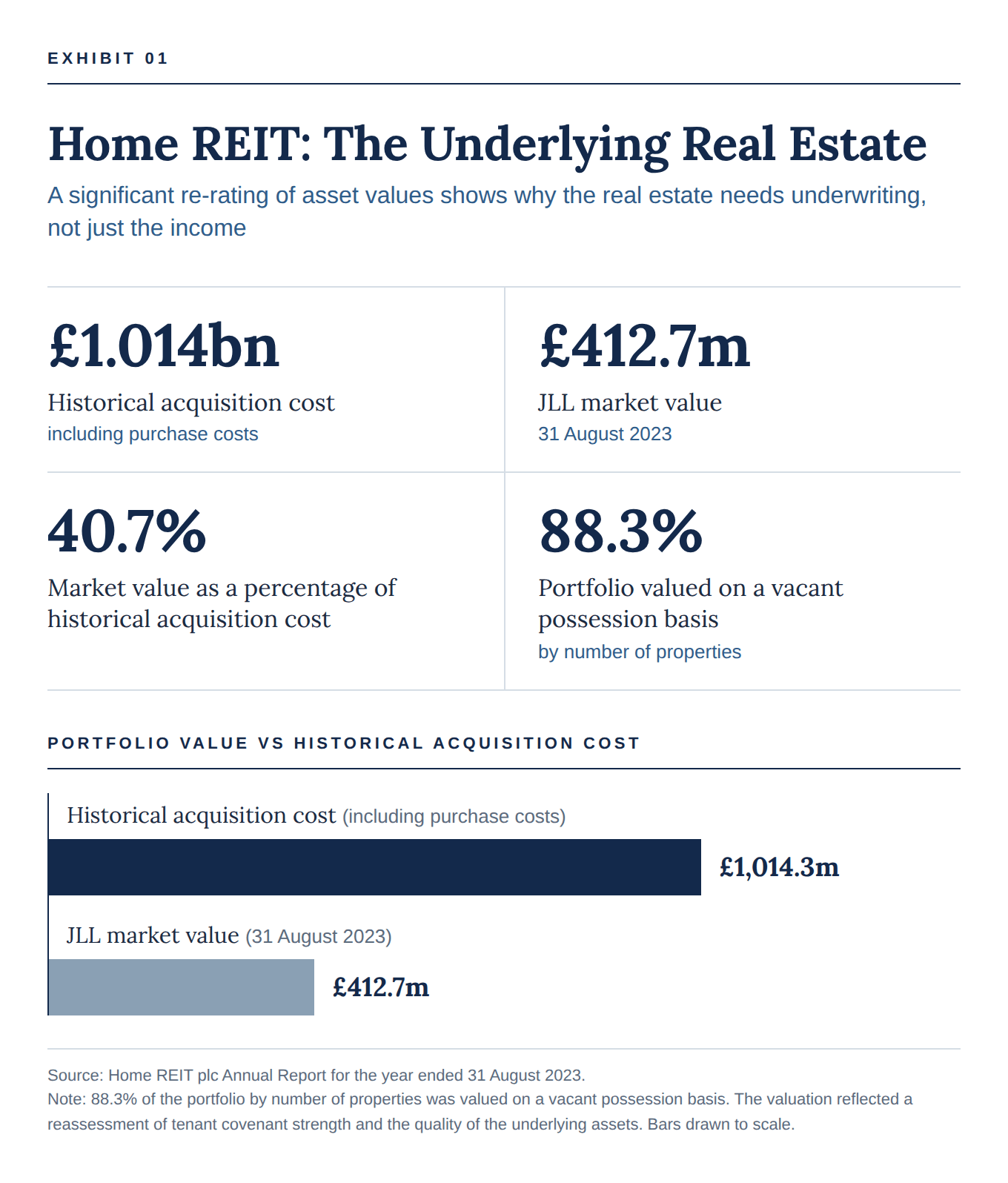
Home REIT portfolio value against historical acquisition cost.
Two ways to underwrite
That is why we think specialist residential should always be underwritten in two ways. The first is as an income-producing asset, considering the counterparty, lease structure, rent affordability, commissioning demand, regulatory position and operating performance. The second is as real estate, considering location, specification, condition, alternative use, reletting potential and vacant-possession value. The two cases should reinforce one another rather than rely on one another.
Our view
None of this weakens the long-term case for specialist residential. The listed market has shown instead that structural demand is not, by itself, sufficient protection against weak covenant, poor governance or an asset acquired at the wrong value.
Specialist residential can produce attractive, long-duration income, but the quality of that income has to be established rather than assumed. As more institutional capital enters the sector, the distinction between owning a long lease and owning a well-underwritten real estate investment is likely to become increasingly important.